
Numerical modeling of arrhythmias
We have our own written C++-OpenMPI software, called Ithildin, to perform cardiac simulations using different geometries for the heart tissue. For electrogram simulations, we use the open cardiac electrophysiology simulator for in-silico experiments openCARP[1].
With these tools, we can perform a large variety of simulations to study different aspects of cardiac arrhythmias. In forward modeling, we seek quantitative predictions of pattern evolution and electrogram shapes.
[1] Plank, G., Loewe A., Neic. A et al. (2021). The openCARP simulation environment for cardiac electrophysiology. Computer Methods and Programs in Biomedicine 2021;208:106223. doi:10.1016/j.cmpb.2021.106223 *[2] Kabus D, Cloet M, Zemlin C, Bernus O, Dierckx H (2024). The Ithildin library for efficient numerical solution of anisotropic reaction-diffusion problems in excitable media. PLoS ONE 19(9): e0303674. [https://doi.org/10.1371/journal.pone.0303674] (https://doi.org/10.1371/journal.pone.0303674)
Modeling the cardiac electrogram
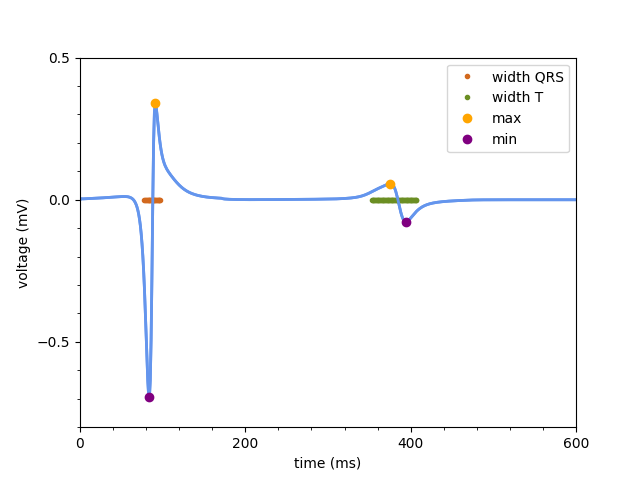
Despite its widespread use, there are still fundamental insights lacking on how substrate parameters affect intracardiac electrograms, and which information can be inferred from electrogram recordings. For this, we are collaborating with A.P. Panfilov (Ghent University) and K. Zeppenfeld (University of Leiden) and P. Claus (KU Leuven).
Creation of individual models from machine learning
Mathematical models of heart function have been historically derived from detailed measurements of currents across the cell membrane. When applying the resulting model to a patient, it is silently assumed that the original model describes also the excitation properties of that person. As an alternative, we use machine learning methods to mimic this entire process and directly learn from recordings taken at the tissue scale in a specific heart.