Contact details
Questions and answers
What did you study for your bachelor’s and master’s degree?
I studied mathematics at Ghent University. During my masters, I focussed on differential geometry and the application of this research onto theoretical physics. My favourite courses were quantum field theory, differential geometry 2 and writing my master thesis.
Why did you choose to do a PhD in this group?
When I was 18 years old, I doubted a lot what to study next. ‘Should I go for medicine, engineering or mathematics?’ was a question I have asked a million people! My passion for mathematics made the decision for me. But to be honest, at the end of my master degree, I was on the verge of starting med school. Being of social value is important to me. But then…this team came across my path. It was THE perfect opportunity to combine my studies with my interest in medicine.
What would you say is your speciality within the research group?
I have always been intrigued by the somehow creative process a mathematician tries to tackle a difficult problem. This way of problem solving is the most important skill my degree has given me and is, I would say, my speciality. ‘Analytical thinking’ is a process: translating a universal problem, like cardiac arrhythmias, to mathematics, (partially) solving the problem by using different techniques, to then translate the solution, like the theory of PDs, back to the ‘real’ world. Being able to practice this skill on one of the largest causes of death worldwide makes me a happy person.
What is your favorite part of doing a PhD?
For my day-to-day life, I would say: diversity! Of course, we do research every day, but we also have to teach, follow courses (also transferable skills) and communicate our research via conferences or events like day of science or children’s day at the uni.
Overall? The fact you learn so much about so many things (including yourself) is priceless.
What is your least favorite part?
A colleague once told me ‘A PhD is a marathon, not a sprint!’. Since I am a long-distance runner, it is quite ironic how hard this long-term process can be. Yes, I do believe a PhD is a long-term process, with lots of long-term management, sometimes with no results. Since I am a result-based person, a PhD is not only a process and marathon, it can also be a rollercoaster.
What are your hobbies/after work activities?
Besides long-distance running, I love to eat! Gourmet dining with friends, and colleagues of course, is one of my favourite activities. My friends also call me a professional conversation maker.
Do you have a fun fact about yourself that you want to share?
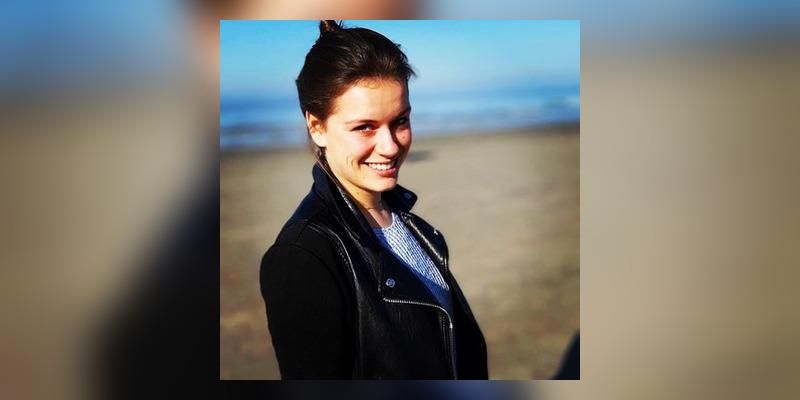
My eyes have a different colour (see picture).