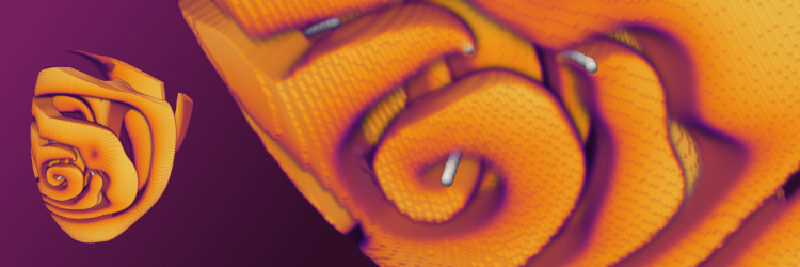
Despite huge advances in the prevention and therapy of cardiac arrhythmias, they are still an important cause of death worldwide.
When heart rhythm disorders affect the lower cardiac chambers (ventricles), which pump blood to the body, the normal pumping of blood is suppressed. This makes ventrical arrhythmias often lethal.
Cardiac arrhythmias that occur in the upper chambers (atria), which pump blood to the ventricles, are not immediately lethal. Still, they cause blood clot formation; it is thought that that cardiac arrhythmias are responsible for at least a third of stroke cases.
Since the heartbeat originates from biochemical processes at the cell scale, understanding and managing cardiac arrhythmias requires an interdisciplinary collaboration: from fundamental science (biochemistry, math, physics, electrophysiology) to the patients’ bedside (engineering, data analysis, cardiology).
An important challenge is the multiscale nature of the problem: how can we relate fast biophysical processes in the cell membrane to large-scale electrical pattern formation in the heart? A first step is the creation of mathematical models, which has been performed over the past 50 years and has lead to better understanding of the electrical phenomena in the heart. To integrate information from the cellular to the organ level can be done not only using numerical simulations, but also with analytical methods.
Join us!
If you are a master student and want to write a master’s thesis on our topics, feel free to contact us.
In particular, bachelor, master and PhD thesis topics are available in several subdomains (and their intersection).
Depending on the candidate, the project can be oriented more towards theory or applied science:
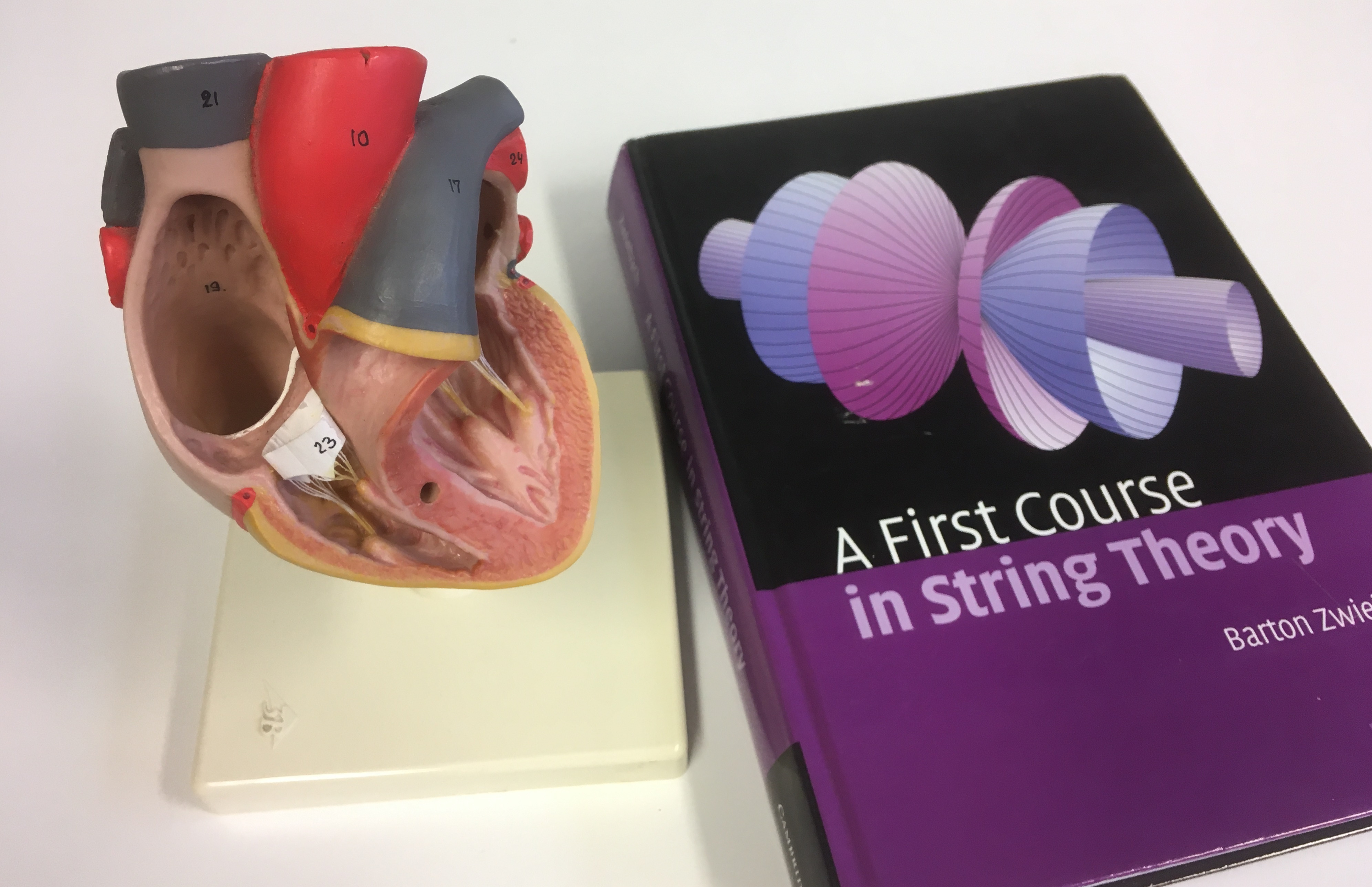
- theoretical/mathematical: differential geometry in the heart, topology of emerging patterns, curvature-driven dynamics, asymptotic solutions to partial differential equations, particle-like analysis using Feynman diagrams, analogies with string and brane theory.
- computational: forward and inverse solutions of non-linear wave propagation in a cardiac geometry, physical models for the generation of electrical signals inside the heart.
- applied: finding phase defects in movies of cardiac activation, estimate cardiac activity from deformation images, uncovering the physical laws governing phase evolution from data, machine learning, uncertainty quantification using Bayes’ rule.
Previous thesis topics
- Check out previous master thesis topics via the tag: Master thesis
- BSc:
- Interaction laws between spiral waves: Debora Hoogendijk (2025, Mathematics)
- Determining the dimension of the attractor in the heart: Maxime Devos (2022, Mathematics)
- Monodomain simulations of the ventricles during sinus rhythm: Phebe Coussens (2022, Mathematics)
- Chaos and Brownian motion in the heart: Lore Zwaenepoel, Ine Malfait and Jade Pauwelyn (2021-2022, Physics)
- Counting cell nuclei using machine learning: Quentin De Rore, Ibrahim El Kaddouri, Emiel Vanspranghels, Henri Vermeersch (2021, Engineering)
- Numerical detection of phase defects in optical mapping data: Jan Quan, Maarten Vanmarcke and Nhan T. Nguyen (2020, Engineering)
- Imposing transmural differences in action potential duration via Laplace’s equation: Dieter Debrauwer, Joren Matthys (2020, Mathematics)
- A cellullar automaton for cardiac excitation: Niels Bertier, Nika Pountouchachvili, Xander Fransen (2020, Mathematics)
- Calculating the ECG from a cellular automaton: Marie Cloet, Emiel Raveschot (2020, Mathematics)
- Stimulating the heart from the Purkinje fibres: Aldo Doggen (2020-2021, Mathematics)