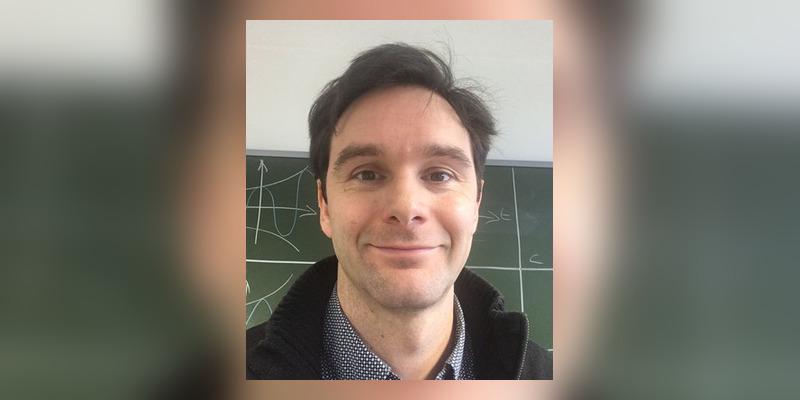
Welcome to my group page!
Since 2006 I am researching non-linear waves and emergent phenomena using techniques from mathematical physics. The main motivation for this comes from cardiac arrhythmias, where self-organizing vortices underly rhythm disorders. This is a major health challenge, see this chart of the World Health Organization.
From 2019-2024 I worked as Assistant Professor at KU Leuven at the Kortrijk Campus.
Since 2025 I am Associate professor at the Leiden University Medical Center. Our mission is to help cardiologists to better understand and visualize the complex spatiotemporal activation patterns in the heart.
We have different methods in our toolkit, ranging from theory (topology, differential geometry, perturbation theory) over numerical methods (forward and inverse modeling) to recent work on clinical data analysis and machine learning. But the most exciting is to combine all of these, enabling the creation of a physics-based cardiac digital twin!
Feel free to contact me, we are open to collaboration.
Contact details
- 📌 LUMC, Albinusdreef 2, ZA 2333 Leiden. Office D4-26G.
- 📧 Official LUMC webpage #- 📚 Publications via Lirias
- 📑 Publications via ORCID #- 🧑🏫 Link educational tasks
- 🌍 Profile on LinkedIn
Questions and answers
What did you study for you bachelor's and master's degree?
I have a Bachelor's and Master's degree in Applied Physics Engineering (NL: burgerlijk natuurkundig ingenieur) and a Bachelor's degree in Mathematics.
What was your PhD about?
Applying elements of string theory to the heart, in order to derive the laws of motion of rotor filaments in the anisotropic cardiac wall. A pdf version of my thesis is available here.
What would you say is your speciality research wise?
Geometric thinking on emergent patterns in the heart.
Why did you choose to become a Professor?
My research is my way to make a difference for science and for society. I deliberately chose a topic with implicit benefits for the public (patients).
What is your favourite part about being a research team leader?
To have my ideas multiplied among my students, and the work divided. To have the aha experience with every little or larger scientific discovery. To spread the word that math and physics are much wider applicable than is usually assumed.
What is your least favourite part about being a research team leader?
Having to choose between a myriad of possibilities to do interesting science.
What are your hobbies/after work activities?
Spending time with my wife and three wonderful kids.
Do you have a fun fact about yourself that you want to share?
No, you'll have to meet me in person for that.