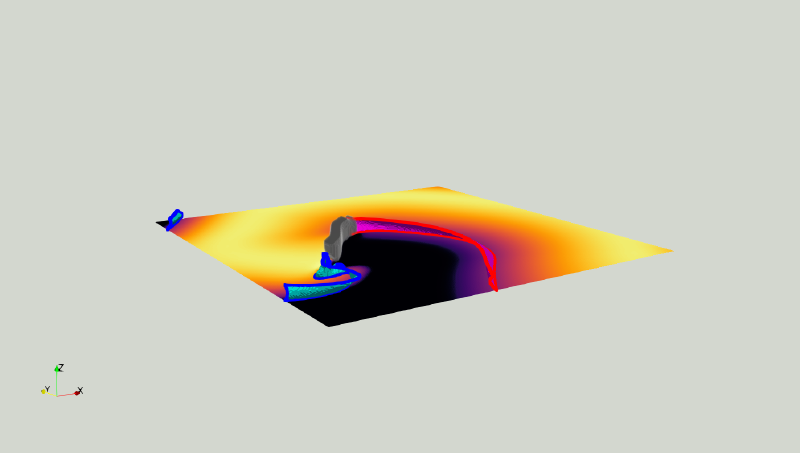
There are many open questions on how the patterns of electrical activity are organized inside the cardiac wall. Our paper in Physical Review Letters sheds new light on this: the conduction blocks that create and sustain arrhythmia can be quite general surfaces, with handles and side branches. The special points (quasi-particles, cardions) that we identified in surface recordings, now become three types of closed curves.
We also got two mathematical bonuses: the twiston seen in simulations by Fenton and Karma (Chaos, 1998) is a cardion of co-dimension 3, and one can create an untwisted scroll wave that rotates around a M"obius strip!
In view of future applications, we present a mathematically consistent way to classify and analyse three-dimensional patterns in excitable media.